


Prep Pak Mini — Cordless Heated Lunch Box
Prep Pak Mini — Cordless Heated Lunch Box
Couldn't load pickup availability
- Free US shipping · arrives in 2–4 weeks (15–28 days)
- Start it about an hour before you want to eat
- 30-day returns · you won't need to ship it back
Meal three. 2pm. No microwave anywhere.
You prepped it Sunday. You carried it all morning. And now you're about to eat cold chicken and rice out of a container in a break room, a truck, a locker room, or a hallway at a show — because there's no outlet and no microwave, and there never is.
The Prep Pak Mini warms it where you are. No cord, no water, no microwave. Press the button, wait, eat a warm meal.
Switch it on well before you want to eat. We'll publish the exact timing once we've bench-tested the current unit.
The measured number
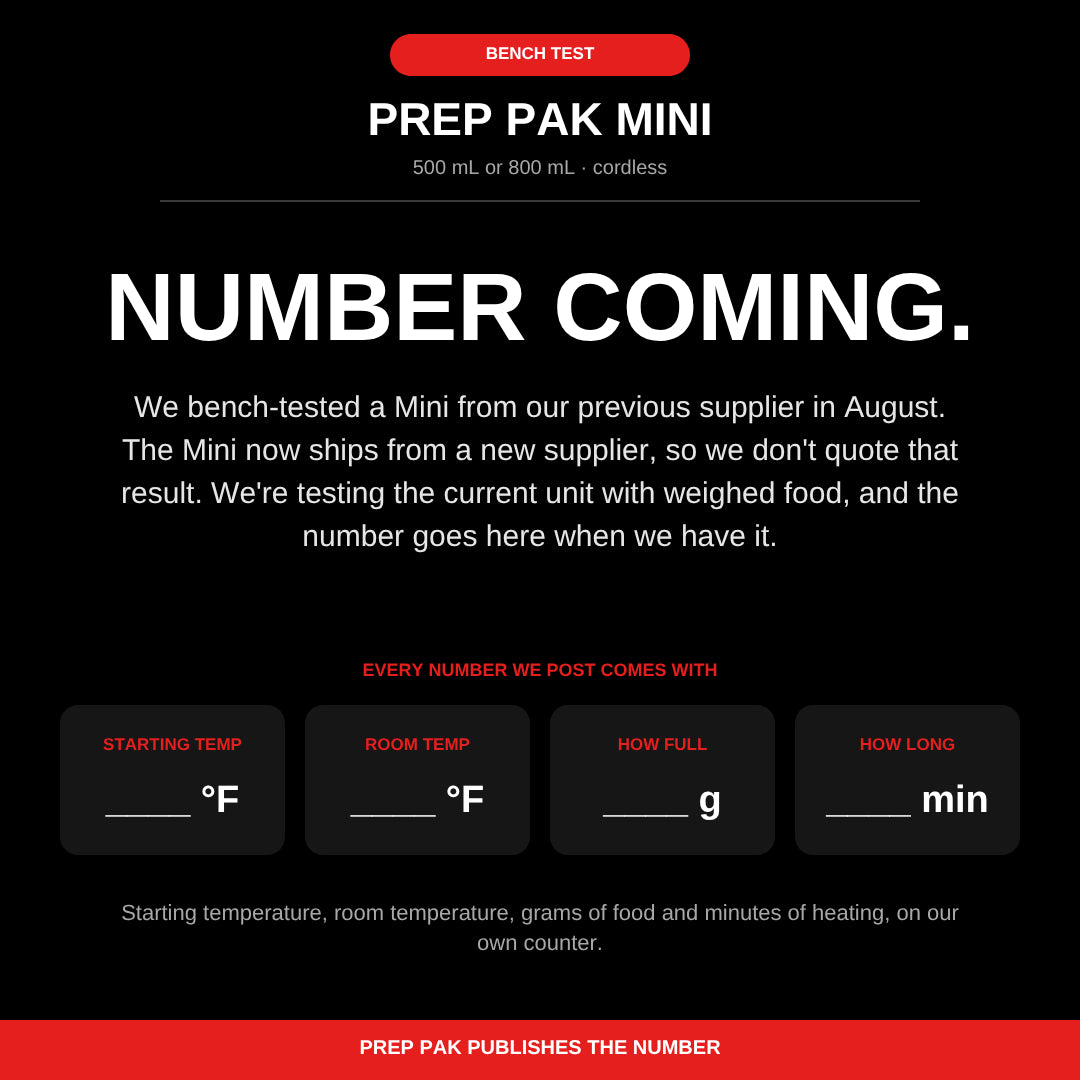
We only publish a heat number with the conditions that produced it: the starting temperature, the room temperature, how much food and how long.
We bench-tested the Mini in August 2026 on a unit from our previous supplier. The Mini now ships from a new supplier, so we don't quote that result for the boxes on sale now. We're testing the current unit with weighed food, and the numbers will go on this page when we have them. We're not going to estimate them for you.
What we won't dress up
No heated lunch box we've tested has reached 140°F in an hour of heating. 140°F is the food-safety hot-hold line. So treat the Mini as a device that warms the meal you're about to eat — not one that keeps food safe for hours.
Keep your meal refrigerated until you start the cycle, and eat it when the cycle finishes. If you pack rice, that matters more than usual: cooked rice held between 40°F and 140°F is the textbook Bacillus cereus risk, and reheating does not undo it.
That is a real limitation, and every product in this category has it. We would rather you hear it from us than find out at lunch.
One thing to do before you press start
The Mini's inner lid has a silicone pressure relief valve: open it before you start a cycle, and keep the container lid on while it heats. Heating a sealed container with the valve shut is a pressure problem, not a cosmetic one — open it every time, no exceptions.
What it is
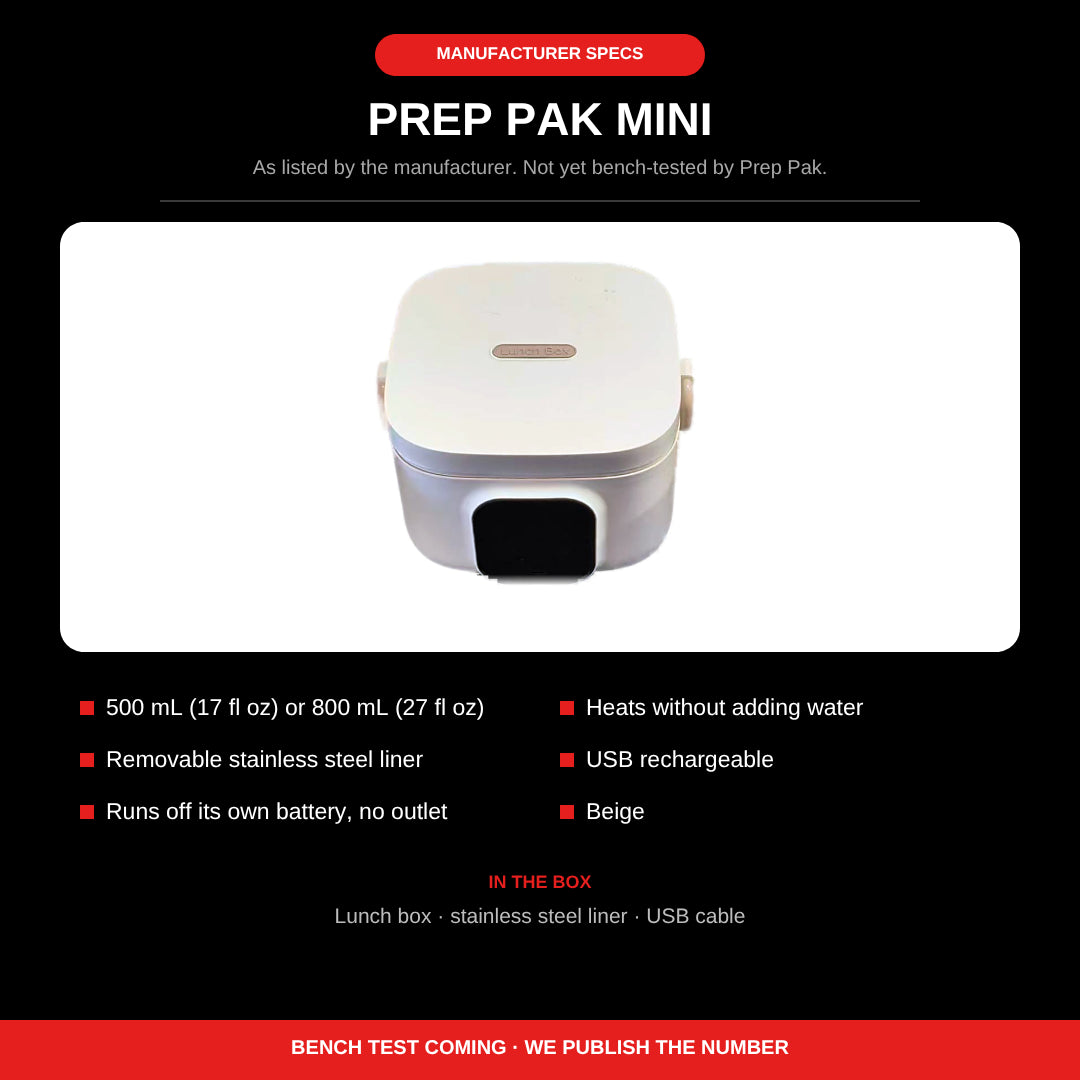
- 500 mL (17 fl oz) or 800 mL (27 fl oz) removable stainless steel liner
- Cordless — runs off its own battery. No outlet, no car adapter, no cable trailing across a break room
- No water needed. Nothing to fill, nothing to spill, nothing to pour out afterwards
- USB rechargeable
- Beige
As listed by the manufacturer. Not yet bench-tested by Prep Pak.
In the box
Lunch box, removable stainless steel liner, USB charging cable.
Questions to ask before you buy
How much food does it hold?
The 800 mL liner holds 27.1 fl oz (about 3.4 cups); the 500 mL holds 16.9 fl oz (about 2.1 cups). For heating, aim for roughly 16–18 oz (454–510 g) of food in the 800 mL and 10–11 oz (285–320 g) in the 500 mL, spread about 1 inch deep. That's our starting guidance from research, not a measured result yet; the weighed-food test will confirm or change it.
How long before I eat should I start it?
We'll publish this once we've timed the current unit. Until then, start it well ahead of your meal and check that the center has warmed before you eat.
How long does it stay warm after the cycle ends?
Plan to eat when the cycle finishes. We haven't measured how fast a meal cools once heating stops. It's a reheater, not a thermos.
Can I heat a frozen meal?
No. Thaw it in the fridge overnight first. A frozen meal needs far more energy to warm than a chilled one, and the outside can feel warm while the center is still cold.
What's the keep-warm mode for?
This model's manual lists keep-warm settings of 104°F, 113°F, 122°F and 131°F. All four sit below 140°F, inside the 40–140°F range where bacteria grow fastest. Use it for a few minutes after the heat cycle at most, never to hold a meal for hours.
Can I heat while it's charging?
No. This model's label says not to use it while charging. Charge it fully, unplug it, then heat on battery.
Can it go in a checked bag?
Carry it on if you can. The FAA says devices with lithium batteries should travel in carry-on bags, and if one goes in a checked bag it should be switched completely off, protected from being turned on by accident, and packed so it can't be damaged. Carry-on batteries can be up to 100 Wh; 101–160 Wh needs your airline's approval. This model's label lists 7.4 V and 30 W (800 mL) or 25 W (500 mL) but doesn't print a watt-hour rating. Our guide to flying with meal prep has the rest.
Shipping
Free standard shipping, United States only. Arrives 2–4 weeks from order. We publish the full timeline — including the stretch at the front where nothing moves and there is nothing to track — on our Shipping Policy page.
If it isn't right
Thirty days, and in almost every case you won't need to send it back. See our Refund Policy.
How we measured this
How we measured this
On 16 August 2026 we filled the stainless liner with fridge-cold water to a consistent level, ran a 30-minute heat cycle, probed with a ThermoPro instant-read thermometer, then ran a second 30-minute cycle and probed again. Room temperature was 77°F. It was filmed.
Two caveats we'd rather state than bury. We filled to a similar level rather than an equal measured volume, so the comparison between our own models carries that confound. And these are water readings, not food. Food heats differently: it takes less energy per degree than water, but it doesn't circulate, so the bottom warms first and the center lags behind.
We are re-running the test with 17.6 oz (500 g) of weighed food in every unit, including the ones we haven't bench-tested yet, and we will publish those numbers when we have them — including the ones that make us look worse.
Battery care and safety
Battery care and safety
These are lithium-battery appliances. Charge over USB. A full charge takes roughly 6–8 hours.
If a unit gets unusually hot, swells, smells of burning, or the battery looks deformed, stop using it and stop charging it immediately. Unplug it, move it away from anything flammable, and email us afterwards. That's the one situation where we'd rather you act first and tell us second.
Cleaning
Cleaning
The stainless liner lifts out. Wash it by hand in warm soapy water. Wipe the heating base with a damp cloth — never submerge the base or hold it under a tap.
We have not tested whether the liner survives a dishwasher, so we are not going to tell you that it does.
Shipping and returns
Shipping and returns
Free standard shipping, United States only. Orders arrive 2–4 weeks (15–28 days) from the day you order. The full measured timeline — including the eight-day stretch at the front where nothing moves and there is nothing to track — is on our Shipping Policy page. You get your tracking number when the shipping label is created. The carrier's first scan can take a few days after that, so a new number may show nothing at first.
If we can't ship inside that window we email you with a revised date and you can cancel for a full refund, no reason needed.
Thirty days to change your mind, and in almost every case you won't need to send it back. See our Refund Policy.
Share

Why there's a temperature on this page
Every heat figure on this site traces to a dated bench test we ran ourselves, with the starting temperature, the room temperature and the elapsed time attached. Nothing here is inherited from a supplier listing.
That includes the limit. None of our units reached 140°F — the food-safety hot-hold line — in an hour of heating. A Prep Pak warms the meal you're about to eat. It does not keep food safe for hours, and nothing else in this category does either.